Most packaging quality problems show up slowly, over months of small complaints. Mithai packaging problems show up in about six hours: by the time a box of kaju katli reaches the customer, the oil has bled through the board, the print has smudged, and a premium product looks like it was packed in a hurry.
This isn’t a design failure. It’s a materials failure, and it’s specific to what mithai actually is: a high-fat-content, direct-contact food product that often sits in its box for days before it’s opened, frequently as a gift, where presentation is doing as much work as taste.
For a commercial buyer placing a bulk order, “does this box look nice” is the wrong first question. The right first questions are about the board itself, and most manufacturers won’t volunteer the answers unless you ask directly.
Why Mithai Is a Harder Packaging Problem Than It Looks
Two properties of mithai make its packaging genuinely different from, say, a toy box or an electronics carton.
High fat and moisture content. Ghee-based sweets, and a large share of Indian mithai is ghee-based, release oil over time, especially in warmer weather or during transport. Ordinary uncoated board absorbs this. What starts as a small grease spot at hour six becomes a visibly stained, structurally softened box by hour twenty-four.
Direct, extended food contact. Mithai frequently touches its packaging directly, without a wrapper or liner in many traditional formats. That makes the packaging itself a food-contact material, not just a container, and that distinction has real regulatory and quality implications most generic packaging conversations skip entirely.
Add to this that mithai is disproportionately a gifting product, bought to be handed to someone else, sometimes to a business relationship worth more than the sweets themselves, and the margin for a packaging failure narrows further. A grease-stained box doesn’t just look bad. It reads as carelessness attached to whoever gave it.
What “Food-Grade” Actually Means, and How to Verify It
“Food-grade” gets used loosely in packaging conversations. For a commercial buyer, it should mean three specific, checkable things:
The board itself is safe for direct food contact. In India, this connects to FSSAI’s packaging norms for food-contact materials. Virgin paperboard is the safer default; recycled board can carry contaminants from its previous life that make it unsuitable for direct contact unless it has a certified food-safe barrier layer between the board and the product.
Inks and coatings don’t migrate. A beautifully printed box is worthless if the inks used for that print aren’t rated for food contact and can migrate into the product, particularly at the fold lines and cut edges where ink coverage is often heaviest. This is one of the most commonly skipped checks in a low-cost bulk order, because it doesn’t show up in a single sample the way a structural defect does.
Adhesives are food-contact rated. Box construction uses adhesive at the seams and base. If that adhesive isn’t food-safe, the food-grade claim on the board itself doesn’t mean much, since the finished box is only as safe as its weakest material.
A straightforward way to verify this before committing to a bulk order: ask your manufacturer directly for their food-grade compliance documentation on the specific board, ink, and adhesive combination they intend to use for your order, not a generic “we use food-grade materials” assurance. A manufacturer who can produce this without hesitation has actually thought about it. One who can’t is guessing.
What “Grease-Resistant” Actually Means
Grease resistance isn’t a single property. It’s usually achieved one of a few ways, each with real tradeoffs:
PE (polyethylene) lining. A thin plastic layer laminated to the inside of the board. Effective and consistent, though it affects recyclability, worth flagging if sustainability is part of your own brand positioning to customers.
Wax coating. Traditional, food-safe, and biodegradable, but generally less durable under heat and pressure than PE lining, and can affect how well print adheres to the surface.
Grease-resistant paper treatments. Specialty coatings applied directly to fiber-based board that resist oil penetration without a plastic layer, a middle ground between the two options above, increasingly common where a brand wants both grease resistance and a genuinely recyclable box.
None of these is universally “correct.” The right choice depends on your product’s actual oil content, expected time between packing and consumption, and whether recyclability is something your own customers care about. What matters for a bulk order is that the choice is made deliberately, based on your product, not defaulted to whatever the manufacturer already has in stock.
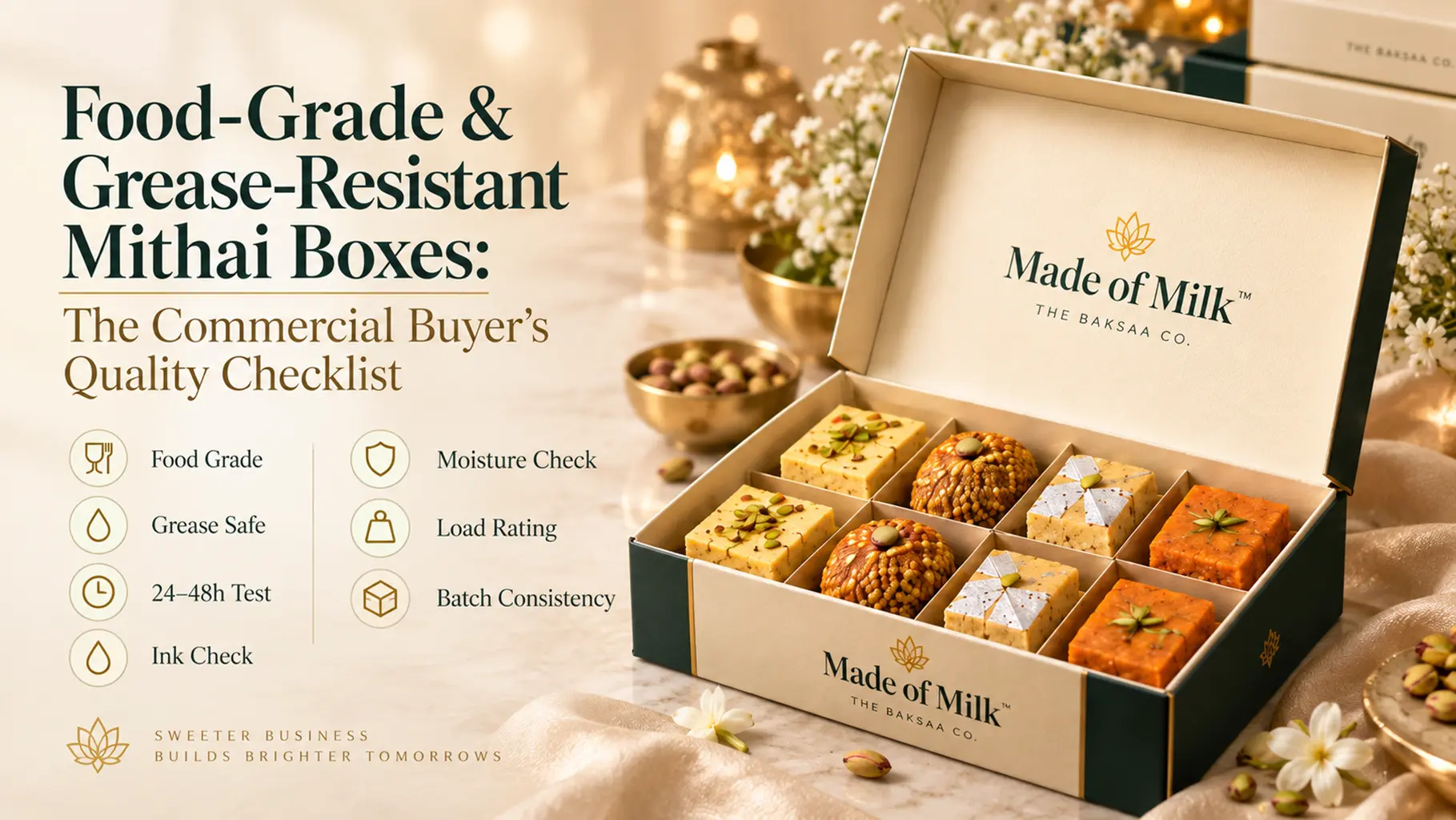
The Commercial Buyer’s Quality Checklist
Before placing a bulk mithai packaging order, verify each of these directly, in writing where possible, rather than assuming they’re covered:
- Confirm food-grade certification for the board, ink, and adhesive as a combination, not the board alone
- Request grease-resistance method used (PE lining, wax, or coated paper) and why it fits your product
- Ask for a real-world test: pack an actual sample of your product and check it at 24 and 48 hours, not immediately after packing
- Verify print and ink adhesion specifically at fold lines and cut edges, where migration risk is highest
- Confirm moisture resistance separately from grease resistance — India’s humidity affects board integrity independent of oil content
- Check structural load rating for your heaviest SKU, not your lightest one
- Ask how consistency is maintained batch to batch, since a food-safety spec that holds for one production run and drifts on a reorder isn’t actually a spec
Why This Matters More at Bulk Volume, Not Less
A single failed box is a customer service problem. A production run of a thousand boxes with an inadequate grease barrier is a brand problem that surfaces during your highest-visibility season, since festive bulk orders are disproportionately gifting orders, seen by more people than a routine retail sale.
This is also where the cost conversation gets misread. A grease-resistant, verified food-grade box costs more per unit than an uncoated equivalent, sometimes meaningfully more. But the comparison that actually matters isn’t box cost against box cost. It’s the cost of one production run against the cost of a customer receiving a stained, compromised gift box with your brand name on it. At bulk volume, that math almost always favors getting the material spec right the first time.
At The Baxsaa Co, this is why material selection for mithai packaging happens before the design conversation, not after it. A design can be adjusted in a week. A material choice made without verifying food-grade compliance and the right grease-resistance method for your specific product is a decision that gets locked into every box in the run.
Frequently Asked Questions
Is FSSAI compliance mandatory for mithai packaging specifically?
Food-contact packaging materials fall under FSSAI’s packaging regulations in India. For a commercial buyer, the practical step is requesting documentation from your manufacturer for the specific materials used in your order, rather than relying on a general industry assumption.
Does grease-resistant packaging cost significantly more?
It costs more than uncoated board, the difference depends on the method used, PE lining, wax, or coated paper each have different cost profiles, but the gap is generally smaller than buyers expect, especially when weighed against the cost of a compromised bulk run.
Can grease-resistant boxes still be fully recyclable?
Coated-paper grease-resistant treatments generally preserve recyclability better than PE lining does. If recyclability is part of your brand promise to customers, this is worth specifying upfront rather than discovering the tradeoff after production.
How do I know if a sample box will hold up over real shipping and shelf time?
Test with your actual product, not a generic filler, and check it after 24 and 48 hours, not immediately. Grease migration and moisture effects are time-dependent and won’t show up in a same-day sample check.
Does box quality actually affect how a mithai brand is perceived?
Yes, more than most food categories, since mithai is bought as often for gifting as for direct consumption. The box is frequently the first thing a recipient sees and touches, before the product inside it.
If you’re planning a bulk mithai order and want the material spec confirmed before committing to a production run, Get a Quote and mention your product’s oil content and expected shelf time — that’s what actually determines the right grease-resistance approach for your order.
Related