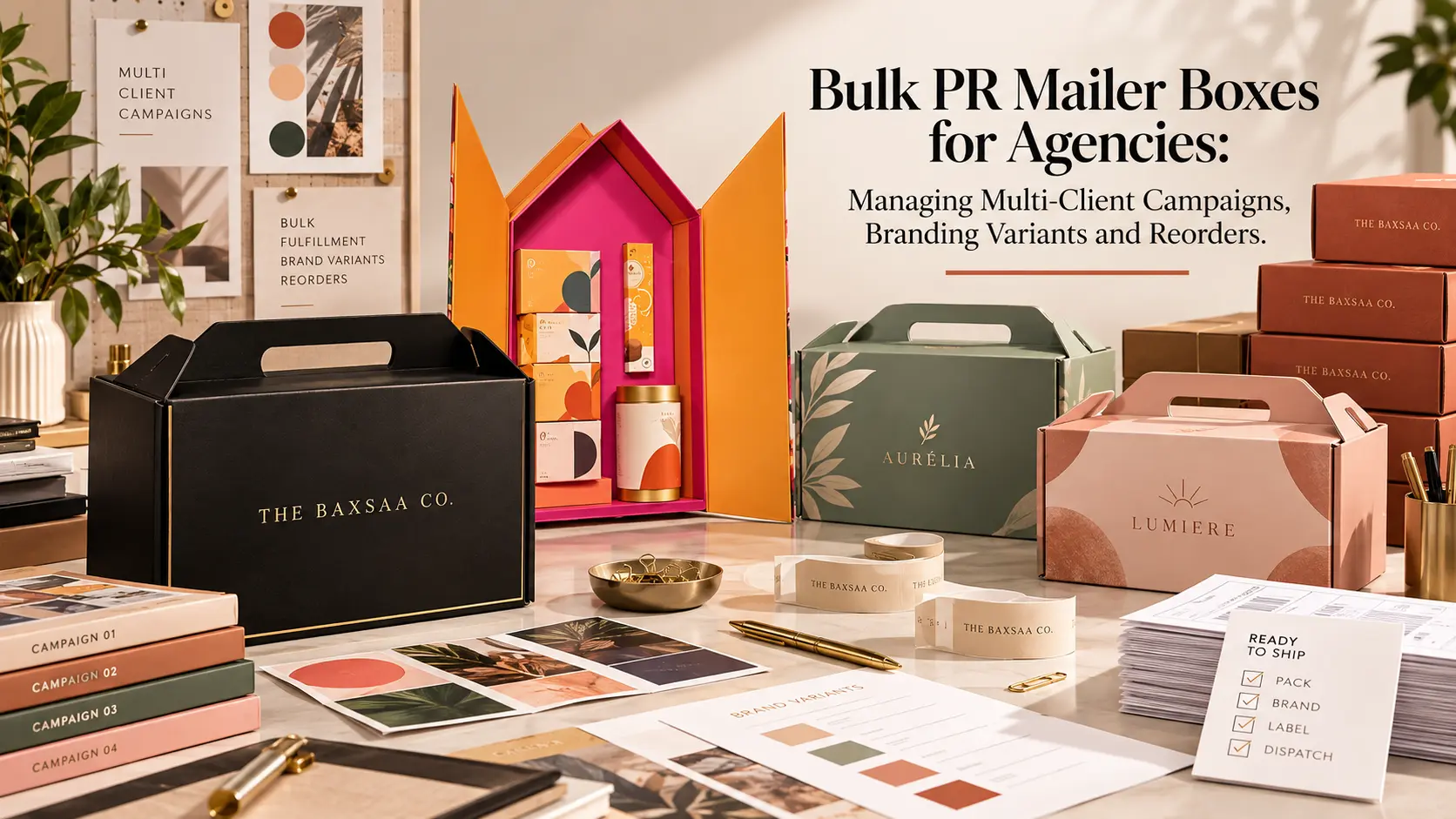
For a brand, a PR box is one campaign. For an agency, it is five campaigns running at once, each with a different client, a different look, a different contact approving it and a different deadline. The packaging has to keep up with all of them.
Agencies that source mailer boxes one client at a time often end up with five suppliers, five sets of tooling, five approval threads and no leverage on price or lead time. Agencies that treat packaging as a managed programme usually spend less time chasing and more time delivering.
This guide is for PR, influencer and brand-activation agencies in India that buy bulk PR mailer boxes for several clients. It explains how to structure a multi-client programme, handle branding variants, work with MOV and keep reorders consistent.
Why agencies need a different packaging approach
Agency packaging has pressures that single-brand buyers do not face:
Many stakeholders: the agency, the client brand and sometimes the client’s legal or brand team all sign off.
Short windows: campaigns are planned around launches and events, so there is little room for reprints.
Mixed volumes: one client may need 300 kits and another 3,000.
Brand protection: a colour or logo error is the agency’s error in the client’s eyes.
Repeat work: successful campaigns come back, and the second run needs to match the first.
A manufacturer who understands this will standardise what can be standardised and keep clear control over what must change per client.
The shared-structure model: one box, many brands
The most efficient way to manage multi-client work is to separate what stays the same from what changes. Pick one proven structure, one insert logic and one shipper, then vary the branding layer for each client.
Element
Shared across clients
Varies per client
Why it matters
Box structure and dieline
Yes, one approved structure
Only if the contents differ
Reuses tooling and keeps cost down
Board and base construction
Yes
No
Keeps quality and lead times consistent
Wrap or print artwork
No
Yes, per brand
Each client gets its own look
Foil, emboss or logo tools
No
Yes, per brand
Brand marks need their own blocks or tools
Insert layout
Often, if contents are similar
When product sizes differ
Fit depends on the actual items
Outer shipper
Usually yes
Optional branded sleeve
Protects boxes and cuts per-job complexity
This is a general framework. Which items can be shared depends on your contents, the structure and your manufacturer’s process, so confirm it against a real specification.
The principle is simple. The structure is expensive to develop and cheap to reuse. The branding layer is cheap to change and essential to get right. When you keep the first stable and the second controlled, you gain consistency and lose very little flexibility.
Handling branding variants without errors
Variants are where agency work goes wrong. Two clients with similar boxes, different colours and a tight deadline is exactly where a mixed-up file or a wrong foil colour appears.
One brand pack per client: logo files, Pantone references, approved colours and finish notes in one place.
Clear naming: file and sample names that carry the client and the version, so nothing is ambiguous.
Written approvals: a signed-off sample per client, not a verbal go-ahead.
Colour references: physical swatches or Pantone codes for brand colours, because screens mislead.
Separate production runs per brand, with labelling that keeps cartons from mixing.
Ask your manufacturer how they keep multiple client jobs separate in the factory. A good answer includes job labelling, sample retention and a final check against the approved sample.
Working with MOV across clients
Custom rigid boxes carry a minimum order value, because of manual finishing and setup. At Baxsaa, our MOV for custom rigid boxes is ₹1,50,000. For an agency, the practical question is how to reach it sensibly.
Ask whether variants of one structure can count towards a single order. Many agencies find this is the best way to serve smaller clients, though terms depend on the manufacturer and the specification.
Plan the first order with a reorder in mind, so the quantity is not sized only for one campaign.
Combine timing where clients launch close together, so one production run covers more than one campaign.
Be upfront with small clients that custom rigid packaging suits campaigns above a certain size, and offer a simpler format below it.
Check each of these with your manufacturer before promising anything to a client. MOV rules are best confirmed in writing for your specific job.
Approvals: how to keep multi-client sign-off moving
Sign-off delays cause more missed deadlines than production does. A repeatable approval process helps:
Agree one sample round per client at the start and treat a second round as an exception.
Send the client a complete package: dieline, artwork proof and finishes list, not just a rendering.
Set a response deadline for approvals and say what happens if it is missed.
Freeze artwork once approved. Late changes can cost new tooling and move the delivery date.
Keep the approved sample as the reference for production and for reorders.
Planning lead times across several campaigns
Work backwards from each client’s date, not from your own. Allow for sampling, approvals, tooling, production and delivery to every destination, then stack the campaigns to see where capacity collides.
List every campaign with its box-in-hand date and destination cities.
Mark the festive and launch peaks, when manufacturer capacity tightens.
Stagger submissions so artwork for all clients does not arrive on the same day.
Ask your manufacturer for a dated plan for the whole programme, not for each job separately.
Planning the programme as a whole usually reveals problems early, when they are still cheap to fix.
Reorders: keeping campaign two identical to campaign one
A reorder is where a good supplier proves its value. The goal is that the second run matches the first, with less effort.
Keep approved samples and specifications for each client on file, and ask your manufacturer to do the same.
Record structure, board, finishes, colours and insert details in one specification sheet.
Reuse tooling where the design is unchanged, which shortens setup.
Flag any change at the time of reorder, as even small artwork edits can affect tooling.
Order before the seasonal peak, when production queues are longer.
Agency sourcing checklist
Use this checklist when you brief a manufacturer for a multi-client programme:
List of clients, kit quantities and delivery dates.
Contents list and dimensions for each client’s kit.
Preferred shared structure and any client-specific exceptions.
Branding requirements per client: colours, logo placements, finishes.
Approval contacts and expected turnaround for each client.
Outer shipper and delivery requirements.
Expectation for reorders and any forecast for repeat campaigns.
Budget range per kit, so options can be proposed to fit.
Questions to ask a PR box manufacturer
How do you keep different client jobs separated through production?
Can variants of one structure count towards a single MOV?
What do you retain after approval to make reorders match?
How do you handle peak-season capacity for repeat agency clients?
Who is my single point of contact across several jobs?
How The Baxsaa Co works with agencies
At Baxsaa, we manufacture custom rigid boxes in Mumbai for brands and agencies, with one specialist managing each order from first sample to final delivery. Browse our rigid box range to see the structures we produce, or read about our perfume box packaging for fragrance-led campaigns.
Running campaigns for more than one client? Get a Quote with your kit contents, quantities and dates and a packaging specialist will respond with options and pricing.
Frequently asked questions
What are PR mailer boxes?
PR mailer boxes are branded packages sent to influencers, journalists or partners to introduce a product or campaign. They combine protective packaging with a designed unboxing moment.
Can an agency order PR boxes for several clients in one order?
Often yes, if the clients share a structure and the manufacturer agrees to treat variants as one order. Confirm this in writing before quoting your clients, as terms depend on the supplier and the specification.
How do I keep branding consistent across client box variants?
Use one brand pack per client with logos, Pantone references and finish notes, keep a signed-off sample for each, and ask your manufacturer to check production against the approved sample before dispatch.
What is the minimum order for custom rigid PR boxes at Baxsaa?
Our MOV for custom rigid boxes is ₹1,50,000. How many boxes this covers depends on the structure, finish and insert, so share your specification and we will confirm what an order looks like.
How can an agency make PR box reorders faster?
Keep specifications and approved samples on file, freeze artwork where possible and reuse existing tooling. Order before the seasonal peak, when production queues are shorter.