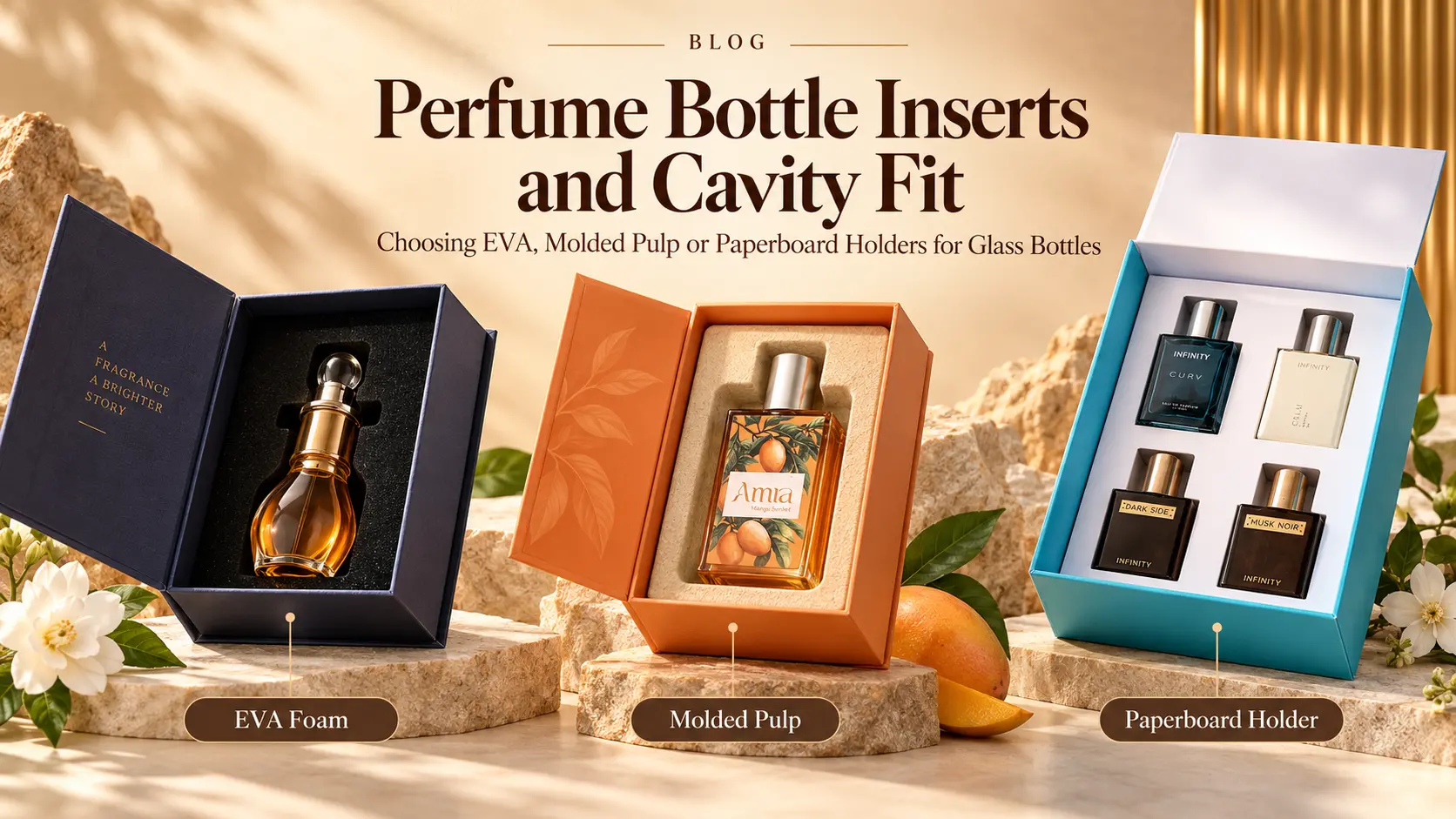
A perfume box can look flawless and still fail. The failure usually happens inside: a bottle that rattles, a cap that scuffs the lid, a glass shoulder that cracks in a courier carton. Customers rarely blame the insert. They blame the brand.
That is why the insert, also called the cavity tray or bottle holder, deserves the same attention as foil or emboss. For fragrance brands that source from a perfume box manufacturer in India, the insert decides whether a luxury box protects what it promises to protect.
This guide explains how inserts and cavity trays work, compares the three most common materials, and sets out the tolerances, tests and specification details that keep your bottles safe and your unboxing consistent at volume.
What an insert actually does
A well-engineered insert does four jobs at once:
Holds the bottle still, so there is no rattle when the box is shaken or shipped.
Absorbs shock from drops and compression during courier and retail handling.
Positions the bottle so the product presents attractively when the box is opened.
Supports accessories such as a travel spray, sample vial, card or candle in a set.
Because glass bottles differ in weight, shoulder shape and cap height, a generic insert rarely works. Custom inserts built for your bottle are standard for luxury perfume packaging.
Three insert types compared
Most fragrance brands choose between EVA foam, moulded paper pulp and a cardboard cavity tray. The table below sets out how they compare.
Factor
EVA foam insert
Moulded paper pulp
Cardboard cavity tray
Look and feel
Soft, premium, can be wrapped in velvet-feel or printed paper
Natural, eco-forward, matte texture
Clean, structured, wrapped in coloured or printed paper
Bottle hold
Excellent grip, absorbs shock well
Good for regular shapes, less forgiving on tall caps
Good when cut accurately, depends on cavity tolerance
Tooling
Die cut or CNC cut, low tooling for runs
Needs a mould, suits larger volumes
Die cut, flexible for design changes
Sustainability story
Weaker, plastic-based foam
Strongest, recyclable fibre
Strong, paper-based and recyclable
Best fit
Luxury and heavy glass bottles, multi-piece sets
Eco-positioned and larger volume ranges
Core ranges and multi-SKU programmes
The right option depends on your bottle, brand positioning, volume and sustainability goals. Your manufacturer can often supply samples of two options so you can compare them with your actual bottle.
EVA foam inserts
EVA foam is the traditional choice for premium fragrance. It grips the bottle firmly, absorbs shock well and can be cut cleanly to a precise bottle profile. It also lets you build multi-level layouts for sets. The trade-off is the sustainability story, since foam is plastic-based, which matters to brands that market on eco credentials.
Moulded paper pulp inserts
Pulp inserts are formed in a mould from recycled fibre. They suit brands that want a natural, recyclable pack and have the volume to justify tooling. They work best with regular bottle shapes. Tall caps and unusual shoulders need careful mould design, and tolerances are less forgiving than a cut foam cavity.
Cardboard cavity trays
A cavity tray is made from board cut and assembled to hold the bottle, then wrapped in coloured or printed paper. It is flexible, fully paper-based and well suited to core ranges and multi-SKU programmes. The accuracy of the cavity cut matters more here than in foam, because board does not compress to hug the bottle.
The measurements that decide fit
Most fit problems trace back to missing or inaccurate measurements. Give your manufacturer:
Bottle height with cap on, and without the cap if it is removable.
Widest diameter or width, and the position of that widest point.
Shoulder shape, collar and any protruding atomiser details.
Bottle weight, filled and empty.
A physical bottle for sampling, ideally three units from the production batch.
Real bottles vary slightly in glass thickness and base shape between batches. A good tolerance allows for that variation without letting the bottle move.
Tolerance: snug, not tight
A cavity that is too tight scrapes the bottle and makes removal hard. One that is too loose lets the bottle shift and defeats the purpose. The aim is a firm, confident hold with easy removal, and it needs to be tested with real bottles, not only measured on paper.
Agree the tolerance in writing against your specification.
Ask for a fit sample made with the actual insert material, not a stand-in.
Check fit with the bottle at room temperature and again after the box has been closed and opened several times.
Testing before you approve mass production
Testing a packed box is cheap compared with replacing damaged stock. Before sign-off, run a short set of checks:
Shake test: closed box, bottle inside, no audible movement.
Drop test: from a realistic height onto a hard surface, on faces, edges and corners.
Compression test: stack weight representative of carton stacking in transit.
Open and close test: repeated cycles to check that the insert does not loosen or scuff the wrap.
If your boxes will ship by courier or be sold online, test them inside the outer shipper too, since that is the condition they will actually travel in.
Designing inserts for sets and discovery kits
Sets add complexity. A 50 ml bottle with a travel spray, or a discovery kit of several vials, needs each item held at the right height and spacing. Multi-level inserts, lift-out trays and ribbon pulls all add cost and assembly time, so decide early which items are essential. Simpler layouts are faster to assemble, which matters when you order custom perfume boxes wholesale.
Insert specification checklist
Include these points when you request quotes so that offers are comparable:
Bottle dimensions, weight and a physical sample.
Preferred insert material, or two options to price side by side.
Wrap paper or surface finish for the cavity tray.
Whether the bottle should lift out with a ribbon pull or finger notch.
Accessories or sample vials to be held.
Outer box structure: shoulder, magnetic or book-style.
First order quantity and annual volume, for bulk perfume boxes in India.
Delivery city, required date and any testing standards you need to meet.
How The Baxsaa Co approaches inserts
At Baxsaa, we treat the insert as part of the box design, not an afterthought. As a fragrance packaging manufacturer in Mumbai, we build custom inserts alongside our rigid boxes and can sample more than one insert material against your bottle before you commit. You can see our perfume box range for formats and finishes we produce.
Have a bottle you need to fit? Get a Quote with your bottle details and a packaging specialist will respond with insert and box options.
Frequently asked questions
What is the best insert for a glass perfume bottle?
EVA foam is the most common choice for premium glass fragrance bottles because it grips firmly and absorbs shock. Paper pulp and cardboard cavity trays are strong alternatives for brands that want a fully paper-based pack. The best option depends on your bottle shape, positioning and volume.
Can perfume box inserts be made in paper instead of foam?
Yes. Moulded pulp and cardboard cavity trays are paper-based and recyclable. They need accurate cavity design to hold the bottle securely, so test a sample with your actual bottle before approving production.
How much tolerance should a perfume bottle insert have?
The bottle should sit with a firm hold and still be easy to remove. The exact figure depends on the insert material and the variation in your glass, so agree a tolerance in writing and verify it with real bottles from the production batch.
Do I need a custom insert for each bottle size?
In most cases yes. Heights, widths and shoulder shapes differ between bottles, so a custom cavity is standard. For multi-SKU ranges, some brands standardise on a few bottle sizes to reduce the number of insert designs and simplify reorders.
How do I test whether my perfume box protects the bottle?
Run shake, drop, compression and repeated open-and-close tests on a packed sample, and repeat the checks inside the outer shipper if you sell online. Do this before approving mass production, since it is far cheaper than replacing damaged stock.