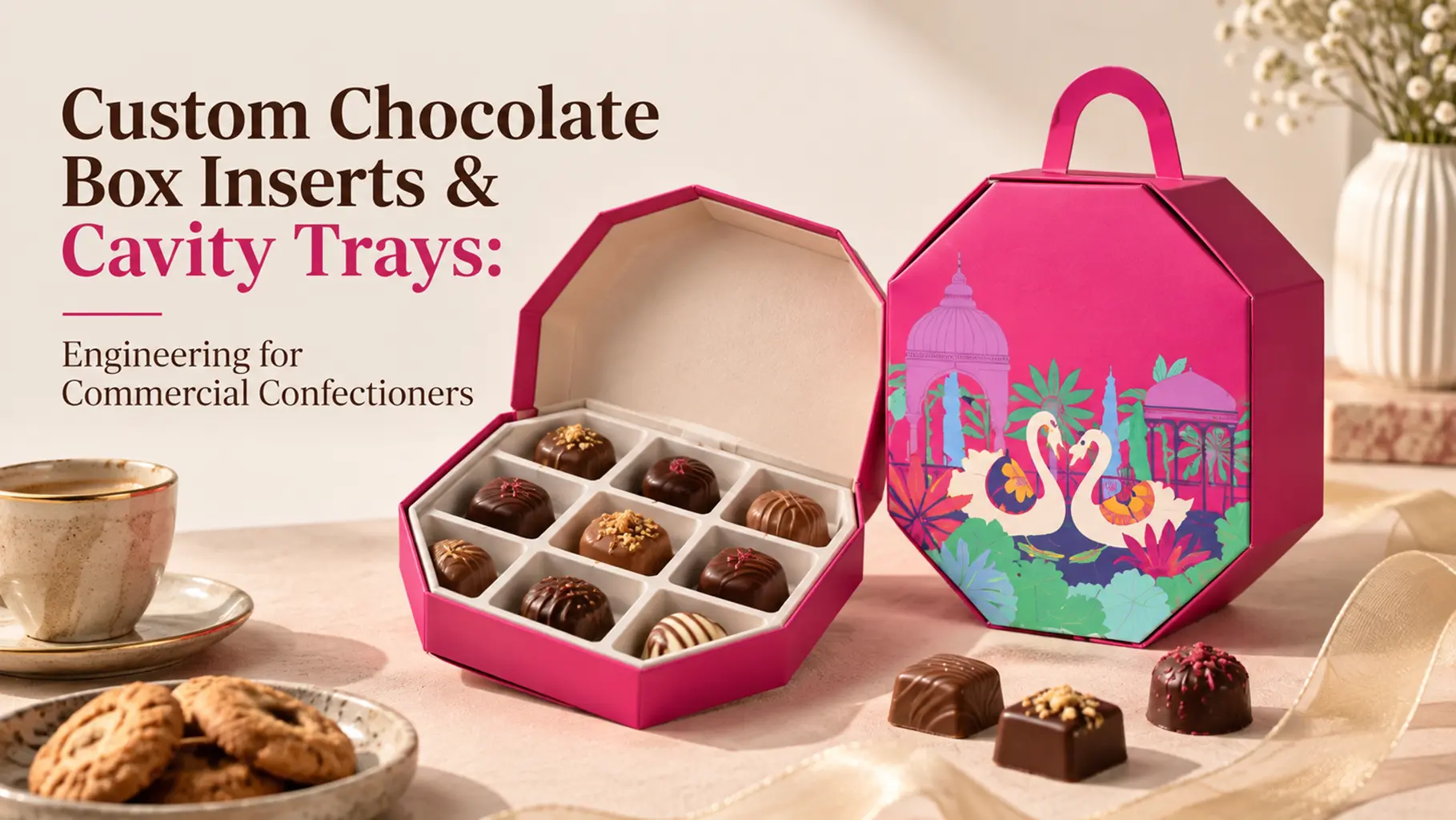
Chocolate is one of the least forgiving products in commercial packaging. It’s brittle enough to chip on impact, soft enough to deform under light pressure, and sensitive enough to friction heat that pieces rubbing against each other during transit can leave visible marks. A box that looks perfectly designed on the outside can still fail the product inside it if the insert holding each piece in place wasn’t engineered for that specific piece.
For a commercial confectioner shipping an assorted box, the insert or cavity tray isn’t a finishing touch. It’s the part of the packaging actually doing the protective work, and it’s usually the part that gets the least attention until something arrives damaged.
Why Chocolate Needs Different Insert Engineering Than Other Confections
Three properties of chocolate make cavity design a genuinely different problem than packaging most other sweets.
Brittleness under impact. Chocolate chips and cracks under sudden force in a way that softer confections generally don’t. A cavity with even a small amount of unwanted movement gives a piece room to knock against the tray or its neighbours during handling.
Sensitivity to friction and heat. Pieces that shift and rub against each other in transit can develop visible surface marks from friction heat alone, well before the box gets anywhere near an actual temperature problem.
Assortment variety within one box. A single box often holds several different shapes and sizes, truffles, bars, moulded pieces, which means a generic one-size cavity grid rarely fits the actual product range well.
What “Custom Cavity Engineering” Actually Means
A properly engineered tray starts from the exact dimensions of each chocolate piece, not a standard template adjusted after the fact. This usually involves a few concrete steps: measuring each piece in the assortment, building a tray layout that holds every piece snugly without excess play, and producing tooling specific to that layout, since a genuinely custom cavity shape needs its own mould, not a modification of an existing one.
This tooling step is worth understanding upfront, since it’s where cost and timeline expectations most often get misaligned. A fully custom tray typically involves a one-time tooling cost before production begins, which is amortized more efficiently across a larger order and is one of the reasons cavity tray customization tends to make more sense at commercial volume than for a very small trial run.
Material Options for Inserts and Trays
PET (thermoformed plastic) trays. Clear, rigid, and precise, PET is the most common choice for premium assortment boxes because it holds an exact cavity shape reliably and lets the chocolate remain visible. The tradeoff is that it’s plastic, which matters if a brand is positioning itself on sustainability.
Molded pulp or paper trays. A genuinely recyclable alternative that’s improved significantly in precision over the last few years. It won’t hold quite as fine a tolerance as thermoformed plastic, but for many assortments the difference isn’t visible to the end customer, and it fits a sustainability-forward brand far better.
Corrugated or cardboard dividers. The simplest and least expensive option, appropriate for less delicate pieces or lower price-tier boxes, but generally not precise enough for a true assorted premium box where each cavity needs to match its specific piece.
None of these is a universal right answer. The choice depends on the fragility of the specific assortment, the price tier of the box, and whether sustainability positioning is part of the brand story being sold alongside the chocolate itself.
Engineering Considerations Beyond the Cavity Shape
Fit tolerance. Too loose, and pieces shift and collide in transit. Too tight, and pieces become difficult to remove without breaking, or the moulding process itself puts stress on delicate pieces during packing. Getting this right usually takes at least one physical sample round, not just a digital drawing.
Tray depth and piece height variance. An assortment with pieces of different heights needs a tray designed around the tallest piece without leaving shorter ones loose, which is a genuinely harder design problem than a single-height assortment.
Fit within the outer box. A tray engineered perfectly on its own can still shift inside a rigid presentation box if the tray-to-box fit itself isn’t accounted for. This is worth reviewing as one system, not two separate design decisions made independently.
Stacking, if the assortment has more than one layer. Multi-layer boxes need the lower tray to support the layer above it without flexing, which changes the material and thickness requirements compared to a single-layer tray.
An Insert Engineering Checklist for Commercial Orders
- Measure every distinct piece shape in the assortment before finalizing a tray layout, not after
- Confirm whether tooling is being built fresh or adapted from an existing mould, and what that means for cost and lead time
- Request a physical sample with your actual product, not a placeholder shape, before approving fit tolerance
- Decide on PET, molded pulp, or cardboard based on fragility and brand positioning, not just unit cost
- Review tray fit inside the outer box as one combined system
- For multi-layer assortments, confirm the lower tray’s load-bearing capacity separately from the upper one
Why This Is Worth Getting Right Before Scaling Production
A cavity tray that’s slightly wrong doesn’t usually fail on the first order. It fails inconsistently, a small percentage of pieces chipped or shifted per batch, which is exactly the kind of defect rate that’s easy to dismiss individually and expensive to ignore at scale. For a commercial confectioner running regular production, the cost of correcting tray engineering after tooling is already built is meaningfully higher than getting the fit right during the sample stage.
At Baxsaa, insert and cavity engineering is treated as its own design step, handled alongside the outer box rather than as an accessory decided at the end, since the tray is frequently doing more of the actual protective work than the box itself.
Frequently Asked Questions
Does every chocolate assortment need a fully custom cavity tray?
Not necessarily. Simpler or less delicate assortments can work with a semi-standard tray layout. Fully custom tooling makes the most sense for premium, multi-shape assortments or once volume is high enough to amortize the tooling cost efficiently.
How long does custom tray tooling typically take?
It varies by complexity, but it should be planned as its own lead time separate from box production, not assumed to happen in parallel at no extra time cost.
Are molded pulp trays sturdy enough for premium chocolate boxes?
Modern molded pulp trays have improved significantly and work well for many assortments. For extremely fine tolerance requirements, PET still holds a slightly more precise cavity shape, but the gap has narrowed.
What’s the most common cause of chocolate damage that insert design could have prevented?
Loose fit allowing pieces to shift and collide during transit, followed closely by trays not accounting for the tallest piece in a mixed-height assortment.
Should insert design be finalized before or after the outer box design?
Ideally together. A tray that fits perfectly on its own can still shift inside a box that wasn’t designed with that exact tray dimension in mind.
If you’re developing or refining a chocolate assortment box and want the cavity engineering reviewed properly, Get a Quote with your piece dimensions and assortment mix, and we’ll work through fit and tooling requirements before committing to a production run.
Related