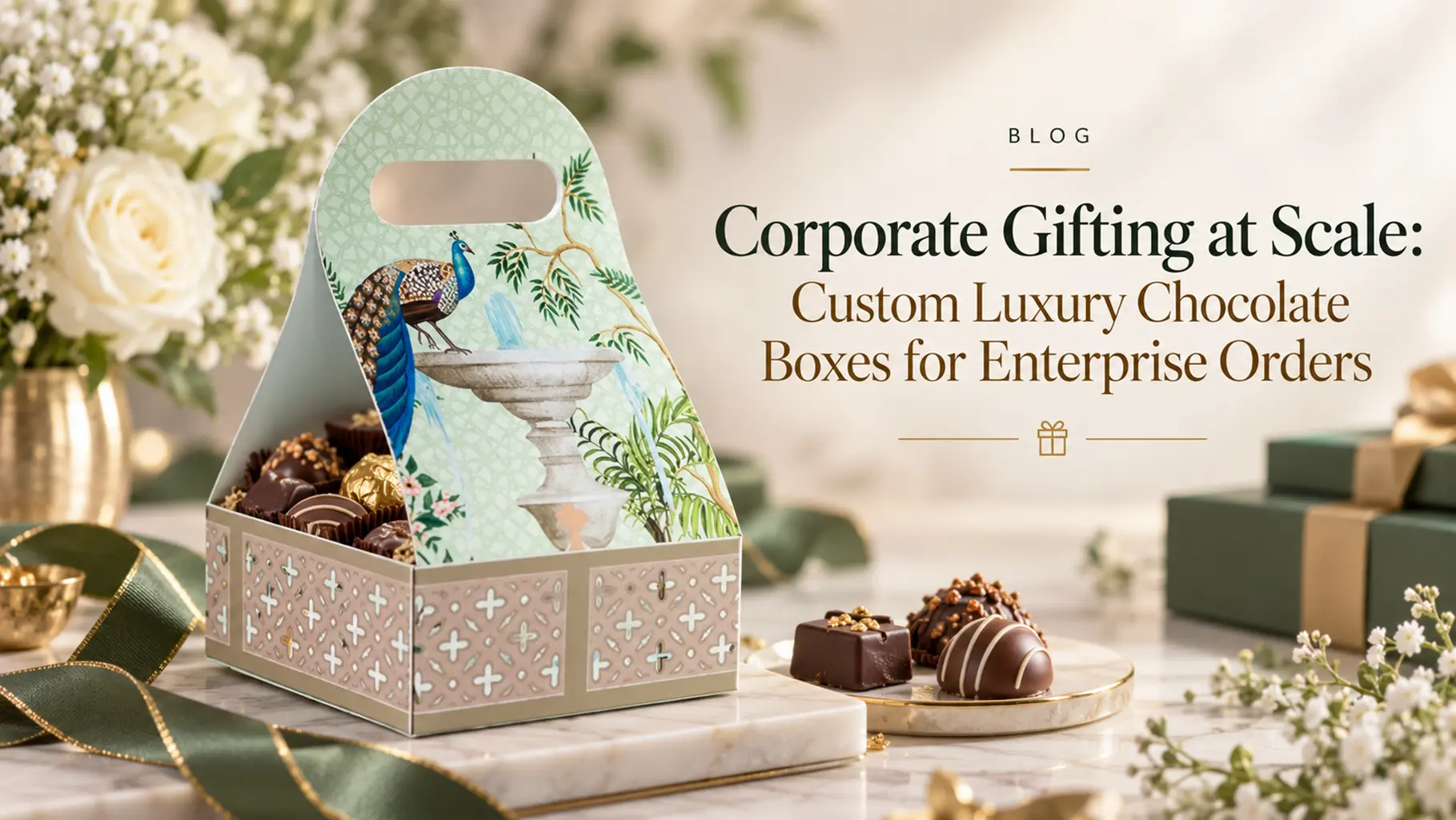
A retail chocolate box has one brand on it: the chocolate maker’s. A corporate gifting order usually needs two, the chocolate brand’s and the company sending it, and sometimes the second one matters more than the first. When a business sends five hundred chocolate boxes to clients or staff, the box is doing a job the chocolate itself can’t: carrying the company’s name into someone else’s office or home, in a form nice enough to be kept out rather than thrown away.
This is what makes enterprise chocolate gifting a different planning problem than either retail packaging or even bulk mithai procurement. It’s not really about the chocolate. It’s about a branding decision that happens to involve chocolate, ordered at a scale and on a timeline most procurement or HR teams only handle once a year.
Why Corporate Gifting Is a Branding Project, Not Just a Bulk Order
Three things separate enterprise chocolate gifting from a standard bulk packaging order.
Co-branding is usually required, not optional. The company’s logo needs to appear on the box, sometimes prominently, sometimes as a subtler mark alongside the chocolate brand’s own identity. This is a design and production decision most consumer chocolate packaging never has to solve.
Recipients notice inconsistency more than product buyers do. A retail customer buying one box has nothing to compare it to. A hundred employees or clients receiving the same gift on the same day absolutely will compare notes, in person or in a group chat, if the finish, print, or fill quality varies across the batch.
It’s frequently a once-a-year decision made under time pressure. Most enterprise gifting concentrates around Diwali and year-end, which means the team planning it often hasn’t done this exact task since the same period last year, and is relearning the process while the clock is already running.
Planning the Corporate Gifting Calendar
For a company gifting to more than a couple hundred recipients, a realistic planning window looks like this:
8-10 weeks out: Finalize recipient count and tiering (see below), and get budget sign-off. This is the step that most often slips, since it usually needs approval from more than one internal stakeholder.
6-8 weeks out: Confirm branding assets (logo files, approved colors) and lock the box design with your manufacturer. Using an old or low-resolution logo file is a common, entirely avoidable delay at this stage.
4-6 weeks out: Production run, with a sample approved from the actual batch, not a separate proof, before the full quantity is finalized.
2-3 weeks out: Delivery to a central location for internal distribution, or coordinated shipping if gifts are going directly to client addresses rather than through the company’s own office.
Enterprise orders that start this process inside four weeks of the actual gifting date are the ones most likely to end up compromising on either branding quality or delivery timing, sometimes both.
Budget Tiering: One Order, Multiple Gift Levels
Most enterprise gifting programs aren’t actually one gift. They’re two or three, differentiated by recipient level: a standard box for general staff or smaller clients, and a premium tier, often with better chocolate, a more elaborate rigid box, or additional inclusions, reserved for senior leadership, key clients, or top-tier partners.
Planning this as a single order with clear tiers, rather than as several separate last-minute requests, is where most of the cost and timeline efficiency actually comes from. A manufacturer can plan one production run with two or three SKU variants far more efficiently than fulfilling three unrelated smaller orders placed weeks apart.
What Custom Branding Actually Involves
Logo placement and finish. Foil stamping and embossing read as more premium than flat printing, and are usually worth the difference for a client-facing tier, even if a simpler printed logo is perfectly fine for a general staff gift.
Color matching. A company’s brand color needs to print consistently across a production run of hundreds or thousands of units, which depends on the manufacturer working from an actual color reference, not an approximate match by eye.
Insert cards or messaging. Many enterprise orders include a printed card, a festive greeting, a thank-you note, or both, produced alongside the box rather than added separately, which keeps the whole package feeling designed rather than assembled.
Chocolate quality matched to the box. A premium rigid box around mediocre chocolate reads as insincere to anyone who opens it. This is worth a direct conversation with whoever is sourcing the chocolate itself, separate from the packaging decision, so the two are matched rather than decided independently.
The Procurement Side: What Enterprise Buyers Need That Smaller Buyers Don’t
Corporate procurement teams typically need a few things a smaller retail buyer wouldn’t think to ask for: proper GST-compliant invoicing for internal accounting, a formal quotation process rather than an informal price check, and often a single point of contact who can manage a multi-week production timeline without repeated re-explanation of the brief.
This is a genuinely different buying process from a retail or even a multi-store retail order, and it’s worth confirming upfront that a packaging manufacturer can actually support it, rather than discovering mid-order that invoicing or documentation doesn’t match what internal finance teams require.
An Enterprise Gifting Planning Checklist
- Confirm final recipient count and tier split at least 8 weeks before the gifting date
- Get internal budget and design sign-off before locking production, not during it
- Provide high-resolution logo files and exact brand colors upfront
- Approve a sample from the actual production batch, not a separate mockup
- Confirm GST invoicing and documentation requirements before placing the order
- Decide central delivery versus direct-to-recipient shipping early, since it affects both cost and timeline
- Match chocolate quality to the packaging tier, rather than pairing premium boxes with a generic filling
Frequently Asked Questions
How far in advance should enterprise chocolate gifting be planned?
8-10 weeks before the gifting date for orders beyond a couple hundred units, longer if multiple internal approvals are needed before production can be confirmed.
Can a single order include different gift tiers for different recipients?
Yes, and it’s usually more efficient than placing separate orders. Planning tiers upfront as one production run with SKU variants is generally faster and more cost-effective than three unrelated smaller orders.
What’s needed to get brand colors to print consistently across a large order?
An exact color reference from the company’s brand guidelines, not a verbal description or a screen-based color match, since screen and print colors don’t reliably align without one.
Does corporate gifting packaging need to support formal invoicing?
For most enterprise procurement processes, yes. This is worth confirming with a manufacturer before committing to an order, since not every packaging supplier is set up for formal B2B documentation requirements.
Should the chocolate and the box be sourced from the same place?
Not necessarily, but they should be planned together. A premium box paired with mismatched chocolate quality undermines the impression the packaging was meant to create.
If you’re planning enterprise chocolate gifting for this year’s Diwali or year-end program, Get a Quote with your rough recipient count and tier structure, and we’ll help you plan a production timeline that fits your internal approval process, not just the packaging itself.
Related