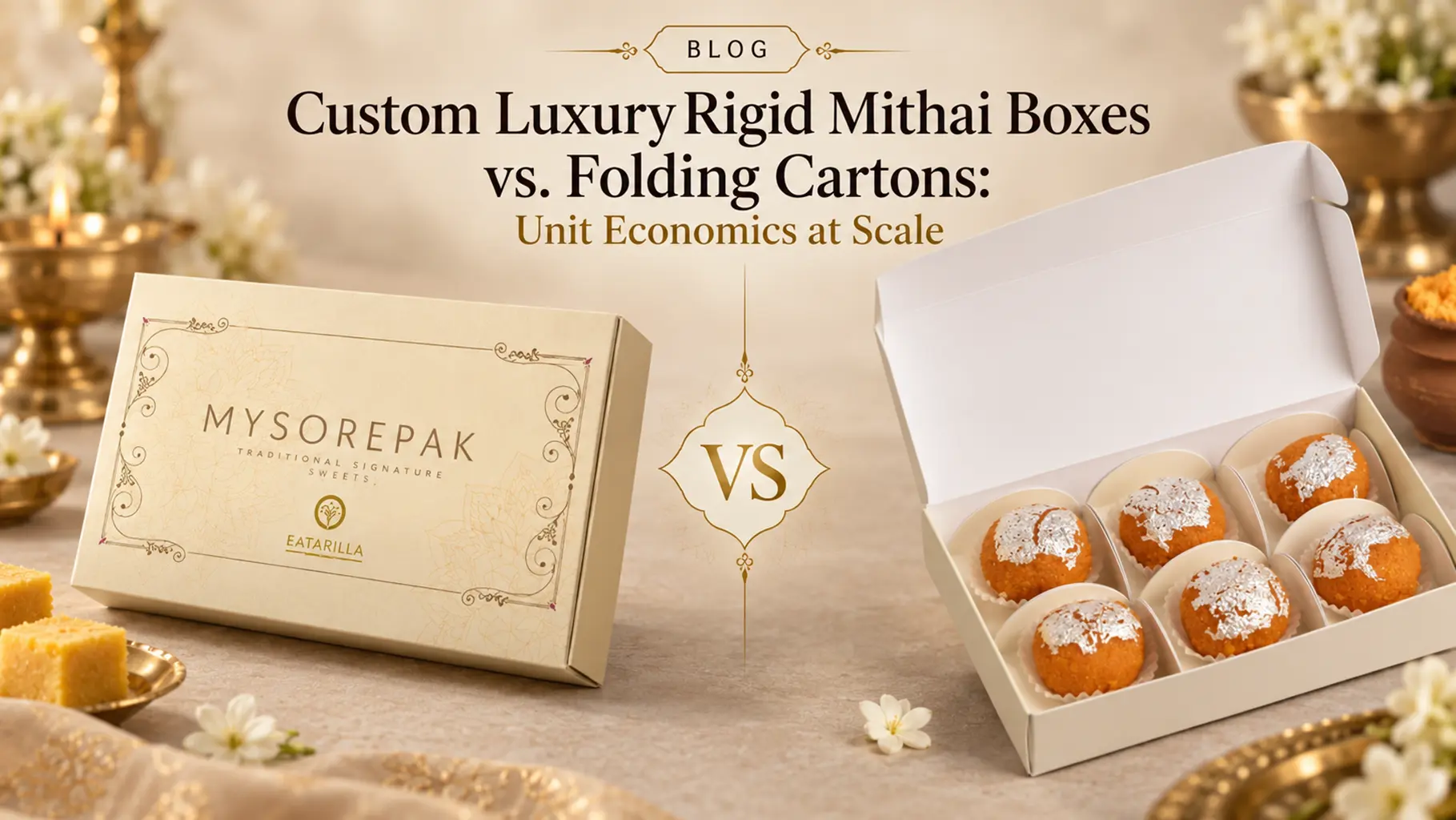
The question sounds simple: rigid box or folding carton? In practice, most buyers answer it by comparing the printed unit price on two quotes and picking the lower number. At small volume, that’s a defensible shortcut. At bulk, it’s the wrong comparison, because the printed unit price is not the same thing as the actual cost per box once it’s in a warehouse and on a truck.
This is the calculation worth doing properly before a large mithai order, especially heading into a festive season where the volume difference between “small” and “bulk” gets compressed into a few weeks.
What’s Actually Different Between the Two
Rigid boxes are built from thick, non-folding paperboard, wrapped in printed or laminated paper, typically assembled as a separate lid and base or with a hinged construction. They’re sturdy, feel premium in hand, and are usually shipped and stored pre-assembled.
Folding cartons are made from thinner, printed paperboard, die-cut and scored so they fold flat and are glued at one seam. They ship and store completely flat, and get erected into their final box shape at the point of packing, either by hand or by an automated erector.
Both can look genuinely premium with the right print finish, foiling, or spot UV. The material difference isn’t really about how nice the box looks on a shelf. It’s about everything that happens to it before it reaches the shelf.
The Comparison Most Buyers Skip: Shipping and Storage
This is the part of unit economics that a per-piece quote doesn’t show you.
A pre-assembled rigid box occupies its full finished volume the moment it’s made: in the factory, in transit, and in your warehouse. A flat-packed folding carton occupies a small fraction of that volume until the moment it’s erected, often for packing, right before it’s filled.
At small quantities, this difference is a rounding error. At bulk festive volume, it compounds directly into freight cost and warehouse space. The same truck, or the same square footage of storage, holds dramatically more folding cartons than rigid boxes, simply because rigid boxes are shipped in their final, bulky shape and folding cartons aren’t.
This is why a rigid box that looks only modestly more expensive than a folding carton on a per-piece quote can end up meaningfully more expensive once landed cost, warehousing, and handling are added in in earnest, and why a folding carton that looks like the obvious budget choice sometimes isn’t once you account for how much easier it is to move and store at scale.
Where Rigid Boxes Earn Their Cost Back
None of this means folding cartons are simply the smarter default. Rigid construction earns its higher cost in specific, real ways:
Structural protection. Rigid walls resist crushing far better under stacking and rough handling, which matters more for delicate or layered mithai arrangements and for anything shipped by courier rather than handed over a counter.
Perceived value at the point of gifting. For premium and wedding-tier mithai specifically, the unboxing experience is part of what’s being paid for. A rigid box signals a price point before the lid is even opened, in a way a folding carton, however well-printed, generally doesn’t.
Reusability. Well-built rigid boxes often get kept and reused by the recipient, which is a genuine, if hard-to-quantify, extension of brand exposure that a disposable folding carton doesn’t offer.
A Practical Way to Decide
The question isn’t really “which is better.” It’s which one matches a specific SKU’s actual job. A useful way to split it:
Use rigid boxes for: premium and wedding-tier gifting SKUs, anything shipped by courier where crush protection matters, and any product where the box price is a meaningful part of the perceived value.
Use folding cartons for: everyday counter sales, high-volume SKUs where landed cost per unit matters more than unboxing experience, and orders where flat-pack shipping and storage savings are large enough to matter given the total quantity.
Many multi-store chains land on a mix: rigid for the top two or three gifting SKUs, folding cartons for the higher-volume everyday range, produced through the same manufacturer so quality and lead times stay predictable even though the specs differ by SKU.
A Quick Unit Economics Checklist Before You Order
- Compare landed cost per unit, not just printed unit price, once freight and storage are factored in
- Calculate the actual volume difference between flat-packed and pre-assembled for your specific order size
- Separate your SKU list into gifting-tier and everyday-tier before requesting quotes for either
- Ask whether courier shipping is involved for any SKU, since that changes how much crush protection actually matters
- Confirm warehouse space is actually available for pre-assembled stock if going the rigid route at scale
- Get both a rigid and folding carton quote for your top SKU before assuming either is the default
Where This Fits Into a Bulk Mithai Order
This decision doesn’t have to be made in isolation from the rest of a festive procurement plan. Rigid box production and sweets and mithai packaging are two different specialisms that a multi-SKU order genuinely needs handled together, since the timeline, minimum order value, and quality checks discussed elsewhere in this series all apply regardless of which material a given SKU ends up using.
At The Baxsaa Co, this tiered approach, rigid for the SKUs that need it and folding carton for the ones that don’t, is usually the more efficient outcome for a multi-SKU festive order than defaulting an entire catalogue to one material.
Frequently Asked Questions
Is a folding carton always cheaper than a rigid box at scale?
Usually per unit, yes, but not always once shipping and storage for the full order are included. The gap depends heavily on order size and how far the boxes need to travel before use.
Can folding cartons look premium enough for gifting mithai?
With good print finish, foiling, or spot UV, folding cartons can look genuinely upscale. What they can’t fully replicate is the structural heft and unboxing feel of a rigid box, which matters more for top-tier gifting SKUs than mid-range ones.
Do rigid boxes need more warehouse space even before an order ships?
Yes. Because they’re typically produced and stored pre-assembled, they occupy their full finished volume from the point of manufacture, unlike folding cartons which stay flat until erected.
Should an entire product line use one material or a mix?
A mix is usually the more efficient answer for brands with a genuine gifting tier and an everyday tier. Matching material to what each SKU is actually for tends to outperform standardizing the whole catalogue on one choice.
How far in advance should this material decision be made for festive orders?
At the same point SKU quantities are finalized, roughly 10-12 weeks out for a multi-store order, since it affects production planning, not just design.
If you’re weighing rigid boxes against folding cartons for an upcoming order, Get a Quote with your SKU list split by tier, and we’ll help you land on the mix that actually makes sense for your volume.
Related